The Nature Nut
Published 5:30 am Thursday, October 30, 2025
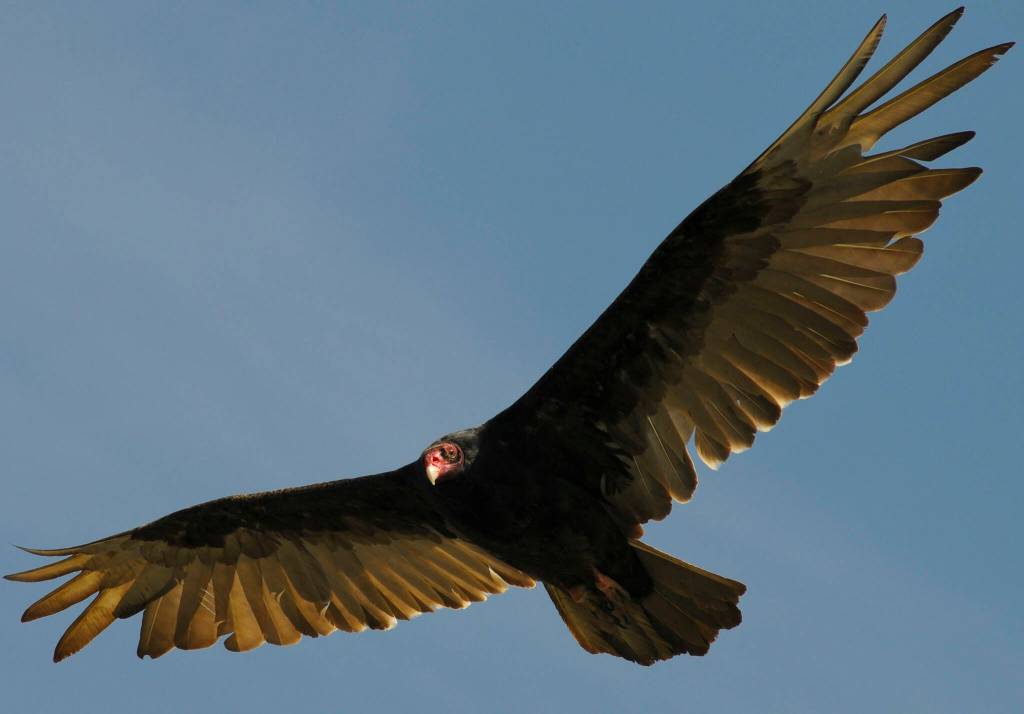
Driving in Smithers on Halloween, I thought I saw a turkey vulture gliding overhead. It was not big enough to be an eagle but was too big for a raven.
It had a small head, a long tail that was not fanned out like a raven’s is and was not flapping its wings but was just gliding or soaring. Just as it came close, it turned its head, which was definitely red.
Although it is uncommon to see one, we do have reports of the odd turkey vulture seen around here, usually on a roadside kill or dead cattle in a field.
When we first arrived in Smithers, we were told by someone from further north that turkey vultures were often seen in the drier interior of the Stikine Valley.
There are also several, more recent, records for the Bulkley Valley on eBird.
Ray Sturney and a friend saw five near Vanderhoof a few weeks ago. All the published maps and descriptions I have seen show turkey vultures occurring only in southern B.C.
Turkey vultures (Cathartes aura) provide an important service, helping clean up our surroundings by feeding primarily on carrion. They can smell dead and decaying flesh from very great distances.
Although they prefer fresh, recently dead, carcases, they will also consume rank, well-decayed, carrion that is covered in dangerous bacteria and other decay organisms. The vulture’s digestive juices are highly acidic, which helps the birds to fight infection from virulent decay organisms.
Because they plunge their heads deep into the rotting flesh, Turkey Vultures have evolved featherless heads – presumably so the feathers do not get all sticky and yucky.
Their heads are also bright red, although no one is sure why. Since the young birds do not have red heads, it is thought the red color might indicate when a bird is mature.
Turkey vultures are highly social and often roost in large groups; perhaps blushing of their head skin serves as a nonviolent form of communication with others. Or maybe, I wonder, is it merely to disguise their bloody behaviour?
Turkey vultures have some additional seemingly disgusting (to us) habits, such as peeing on their own legs. This could be a way to remove deleterious bacteria they pick up by standing on or in rotting carcases.
When alarmed, turkey vultures are also known to regurgitate as a possible defence mechanism.
My first encounter with turkey vultures occurred shortly after I arrived in Canada from England, where I did not even know turkey vultures existed.
I was invited to go on a botanical field trip to West Virginia with other grad students. One day, we took a study break after lunch by lying in the bright sun for a nap on top of a rocky knoll. Suddenly, I realized I could see through closed eyelids shadows of something circling around above my head. Then someone called out “turkey vultures!” at which we all jumped up to see several circling around above us.
There was really no cause for alarm, as they do not attack and kill. They were just checking us out, of course – after all, to them, anything that lies still might be dead and yummy.