
Sponsored Content
Smithers embraces cleaner air and safer forests with innovative waste-burning technology
Published 6:00 am Monday, November 17, 2025
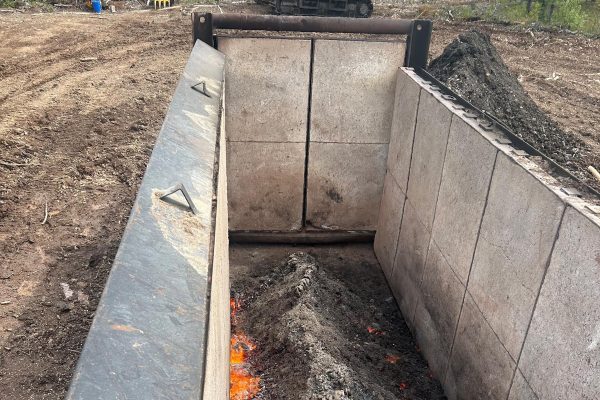
Discover how sustainable forestry and innovation are shaping a healthier future in Wet’suwet’en territory
In the heart of Wet’suwet’en territory just outside Smithers, the Wetzin’kwa Community Forest Corporation (WCFC) is reshaping how communities think about forest stewardship.
Managing more than 30,000 hectares of mixed forest and alpine terrain, WCFC works to balance environmental health, local economic opportunity and cultural responsibility – a model of sustainable forest management rooted in collaboration and respect.
“Our main goal is to reduce waste as much as we can,” says General Manager Sam Coggins. “We wanted a method that was safe, efficient and respected both the land and the people who live here.”
For decades, the standard practice for disposing of forestry waste was open pile burning. – While effective, locals expressed concerns about air quality impacts.
Pile burning typically releases smoke for a short period during burning, and can result in smoldering that carries on for days.Despite using custom ventilation forecasts smoke is released into the valley frustrating residents who already cope with wildfire haze during the summer months.
In the interest of reducing impacts, WCFC has used an air curtain burner that reduced the number of burn piles so much that this year’s pile burning has taken approximately 5 days.
Determined to find a cleaner solution, WCFC introduced an innovative new technology to the Bulkley Valley: the Air Curtain Burner – a pollution-control system that transforms how forest waste is managed.
What is an Air Curtain Burner?
Also known as an Air Curtain Incinerator – Air Curtain Burners work by channeling a powerful stream of air over a burn chamber filled with wood waste.
Instead of letting smoke escape into the atmosphere, the air curtain forces it back into the hottest part of the fire, where the particles are re-burned at a very high temperature. The result is a fast, efficient combustion process.
“Our system eliminates what used to take days or even weeks in just a few hours,” Coggins explains. “It’s safer, cleaner and less impactful for local air quality.”
Because it meets BC Wildfire Service safety standards, the burner can operate year-round – even during summer months when open fires are restricted. That flexibility helps reduce fuel buildup and supports ongoing wildfire risk reduction treatments, an essential part of the region’s forest management strategy.
“Being able to manage residuals immediately after thinning has really increased the efficiency of operations,” says Katelyn Metanczuk, WCFC’s Enhanced Stewardship Coordinator.
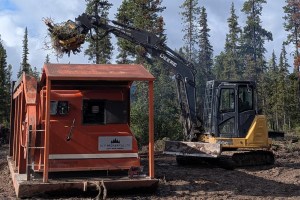
The use of a mini-excavator to load the thinning residuals into the Air Curtain Burner. Photo courtesy Wetzin’kwa Community Forest.
Metanczuk also notes the importance of community partnerships.
“We want to shout out Rob Vanderkooi and his company RCV Mechanical Ltd., who we worked with on the thinning operations and the air curtain burner system. Rob’s expertise has been invaluable.”
Coggins adds that community engagement has been central to the process. “We offered firsthand exposure to the air curtain burner’s operation through field tours, to give our community a greater understanding of this new method of forest waste management.”
The Air Curtain Burners also produces biochar, a natural by-product of clean burning. Biochar acts as a soil enhancer, improving water retention and supporting plant growth.
“Biochar makes a great soil additive for native plants like huckleberries,” Coggins says.
Balancing forest and community
This new approach to forest waste management aligns with WCFC’s broader mission: to protect ecological integrity while supporting local economies.
The project was supported by a grant from the Forest Enhancement Society of BC, which funds initiatives that improve forest resilience and reduce wildfire risks across the province.
WCFC’s work also extends beyond the forest itself. A portion of forest revenue is reinvested locally every year to support non-profits, First Nations, schools and community programs. This is provided through community grants and stakeholder donations.
That focus on local benefit extends to WCFC’s partnerships with small businesses and mills, creating jobs that keep profits within the Bulkley Valley.
“Community forestry means the value of every tree extends beyond the stump,” Coggins says. “From logging crews to local artisans, the benefits stay close to home.”
For WCFC, adopting the Air Curtain Burner is more than an operational upgrade – it’s a reflection of what community-based forestry can achieve.
Cleaner burns mean healthier air. Faster waste removal means safer forests. And every project, from harvesting to habitat protection, is guided by the shared goal of maintaining a sustainable, living landscape for generations to come.
To learn more about Wetzin’kwa Community Forest Corporation visit wetzinkwa.ca or follow them @wetzinkwa on Facebook and Instagram for updates on stewardship projects and community programs.