Clean B.C. review urges accelerating energy transition, questions impact of LNG
Published 10:38 am Wednesday, November 26, 2025
Current emissions targets are not working because they are not achievable. The province’s push to develop natural gas to boost the economy will have climate consequences. And B.C. needs to accelerate the energy transition to reduce emissions.
The results are in from the review of B.C.’s signature climate policy, Clean B.C., and the report’s authors say progress is being made — but not all policies are working.
The review was conducted as part of the deal between the B.C. Green Party and the governing NDP for legislative support.
The report makes 80 recommendations, including that the government ensure a portion of revenue from natural gas projects is put toward clean-energy projects. And other revenues from initiatives such as industrial carbon pricing ought to be put into a climate action fund, rather than general revenues, say report authors Merran Smith and Dan Woynillowicz.
“We think it would be a mistake to have those going into general revenue for the simple reason that British Columbians don’t necessarily see the benefit in paying something extra if it’s not going towards the solutions that they’re seeing,” Woynillowicz said.
Along with these prescriptive measures, the report warns that the massive push for new liquefied natural gas (LNG) development presents problems of “inescapable emissions math.”
“While current policy tools support reducing the gas sector’s [greenhouse gas] intensity, the pace and scale of incremental climate pollution from new LNG projects, and increased gas production and transportation to supply them, would negate reductions from other sectors,” the report says.
Smith and Woynillowicz also question both the projected future economic benefits of LNG development and whether selling cleaner B.C.-made LNG to other countries actually replaces dirtier fuels.
“There needs to be a broader discussion about what the province’s economic future looks like,” Woynillowicz said.
Moving away from targets
In a major departure — and an acknowledgement that past policies were not working — Smith and Woynillowicz urge the province to stop thinking in terms of hard targets, and instead focus on policies and measures that reduce the most greenhouse gas emissions.
“If the message is constantly that we’re not doing enough, that we’re failing, that just deflates everybody,” Woynillowicz said.
This includes an acknowledgement that the target of reducing greenhouse gas emissions by 40 per cent by 2030 is not achievable. These targets need to be lowered and made realistic, at the very least, according to the report’s authors.
Smith did say that B.C. has reduced per-capita and per-unit-of-GDP emissions, but the population and economy have both grown.
The report authors also pan electric vehicle targets, arguing that once uptake gets to 90 per cent, the market should be left to sort out the rest. Part of this is because the cost of electric vehicles is still so high that they are not affordable for everyone.
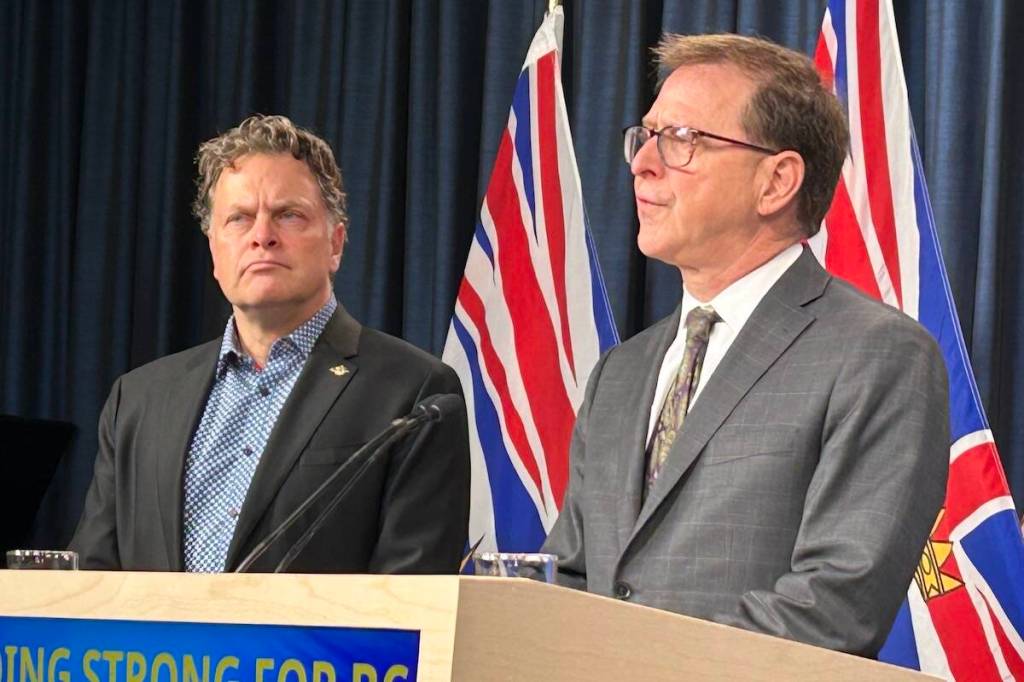
Energy and Climate Solutions Minister Adrian Dix acknowledged Nov. 18 that the target of having electrics comprise 90 per cent of all vehicle sales by 2030 and 100 per cent by 2035 is “no longer realistic.” But he also said he was waiting for the completion of the review and a signal from Ottawa on federal intentions before making a change.
The report’s authors have a different opinion on electric vehicle rebates — both provincial and federal rebate programs have expired or been cancelled — arguing that they ought to be kept in place at gradually decreasing levels, and be income-tested.
Other programs have reached limitations, they say. The report argues that construction step codes have diminishing returns because getting a building to the highest levels costs too much.
“It doesn’t actually make sense to do that,” Woynillowicz said about building to the strictest standards.
Conservative leader says report shows targets not realistic
B.C. Conservative Leader John Rustad jumped on the report as an admission of failure. He called the initial targets of the Clean B.C. policy — labelled world-leading when introduced in 2018 — “virtue signalling.”
“There was no way it could possibly be met,” he said. “And so now we’re seeing the evidence of that.”
He called Clean B.C. “damaging” to the province’s economy, and said that the amount of carbon produced in B.C. is an insignificant portion of total worldwide emissions.
“We cannot be fixated on things like CO2 to the detriment of us as society and of people who just want to put food on the table and build to have a home to live in,” he said.
B.C. Greens MLA Jeremy Valeriote, who took a leadership role in pushing for the review, disagrees, arguing that going green and promoting energy efficiency has a positive impact on affordability.
He also wants the province, despite its relatively small population, to take a global leadership role.
“We’re looking 10 or 20 years down the road to where we need to go,” Valeriote said.
Some of the recommendations will be part of negotiations for the next Green Party-NDP cooperation agreement, he said.
Other parts of the report, the Green Party takes issue with.
The Green Party is not pleased with recommendations to reduce or eliminate targets and to abandon emissions caps. The report’s authors argue these are not helpful because they inspire opposition instead of encouraging action.
Dix said all the recommendations are being “considered,” including the possibility of abandoning or altering targets.
“I’m not disappointed that the report says we need to do better because I agree with that,” he said.