B.C. Premier Eby doesn’t want Alberta’s proposed pipeline to be ‘energy vampire’
Published 1:00 pm Thursday, November 27, 2025
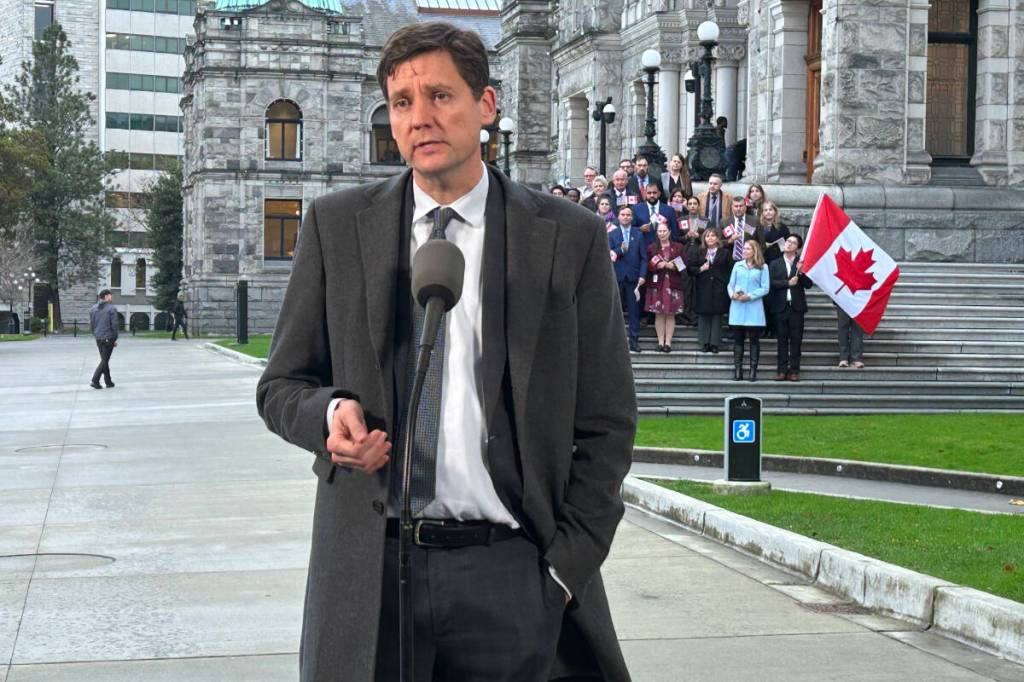
B.C. Premier David Eby says he doubts a new northern pipeline will go ahead without public subsidies and support from coastal First Nations.
He wants to instead steer the conversation toward increasing domestic refining capacity to create more jobs from Canadian oil.
“But the bottom line for us is that we need to make sure that this project doesn’t become an energy vampire,” he said a few hours after an announced memorandum of understanding between Alberta and the federal government to work on getting a new oil pipeline built.
Earlier in the day on Thursday (Nov. 27), Prime Minister Mark Carney and Alberta Premier Danielle Smith signed the deal to get more Alberta oil to Asian markets.
In exchange for federal support, Smith agreed to a slate of climate-related benchmarks, which includes a renewal of the commitment to make Alberta net-zero by 2050. The two sides also agreed to develop a nuclear generation strategy, boost electricity supplied to AI data centres and increase capacity for the Trans Mountain pipeline.
Not everyone within the Carney government is happy — Steven Guilbeault, the former environment minister and current minister responsible for parks and culture, resigned from cabinet in protest.
For many months now, Eby has said he thinks B.C. needs to focus on the projects at hand, not one without a proponent that could endanger First Nation support for more viable projects.
He reiterated this on Thursday, saying he has “anxiety” about “taking our eye off the prize” and distracting the federal government and resources from projects already underway. These include liquefied natural gas export terminals and electrical transmission lines.
The pipeline MOU includes no timelines for construction or development other than a deadline of July 1, 2026, for Alberta to deliver an application to the federal government’s Major Projects Office.
This deal was negotiated without Eby’s involvement and without consulting the coastal First Nations. B.C. Conservative Leader John Rustad said it was clear Eby was kept out of talks because he is “obstructive.”
He faulted Eby for going against the rest of the country, saying this is what is good for Canada and for the people of B.C.
The Business Council of B.C. issued a press release simply titled “This is good,” laying out how it strengthens the economy and helps diversify trade away from the U.S.
Big questions remain
The MOU requires the project to be financed by the private sector, but no company has come forward saying it is willing to build or finance the pipeline.
Eby said he doesn’t think this will happen. He argues a new pipeline will need federal subsidies, pointing to Trans Mountain as an example. It required a federal bailout and is now publicly owned.
Still, the biggest hurdle for the Alberta government to overcome before bringing a project proposal to the federal government next summer will be convincing coastal First Nations to support the pipeline.
The MOU agreement calls for immediate trilateral discussions among Alberta, B.C. and the federal government, as well as “meaningful consultation with Indigenous Peoples.”
There is a federal moratorium on heavy-oil tanker traffic along the north coast of B.C. that would need to be amended or rescinded for a new pipeline to be built — and several coastal First Nations vehemently oppose lifting or creating exceptions to the ban.
B.C. Greens MLA Rob Botterell said the rights and title of these First Nations must be protected, pointing out that the waters where oil tankers would need to travel are some of the most dangerous in the world.
“I know a lot of folks in the Coast Guard, and they’ll tell you that that part of the world is not the part of the world you want to be running a tanker through,” he said.
The MOU commits to “an appropriate adjustment” to the tanker ban should the project be approved.
Coastal First Nations president Marilyn Slett held a press conference on Thursday, restating her opposition to rescinding the tanker ban, saying the nations have no interest in becoming equity partners.
She said that all it would take is one spill to ruin their way of life.
“We are not interested in being equity partners in a project that has the potential to destroy everything that we have built,” she said. “We have never supported oil pipelines. They are not a part of our vision for a healthy, sustainable, and economically diverse north coast.”